Experience Give Me Liberty — Virginia 250's Signature Exhibit in Yorktown
Experience Give Me Liberty — Virginia 250's Signature Exhibit in Yorktown
Aug 28, 2026
America's 250th doesn't end in January of 2027.
The "Give Me Liberty: Virginia & The Forging of a Nation" Virginia 250 Signature exhibit will be on display at the American Revolution Museum at Yorktown until January of 2027. But, as always, this post won't go away in February- instead it will be updated slightly.
Why? Because this exhibit is critical to share and I truly believe it's a portal into understanding the founding of our nation.
I had to miss the special media event hosted by the Jamestown-Yorktown Foundation. Life intervenes with historical education sometimes.
I couldn't be more grateful that I was invited by Media Relations Manager Tracy Perkins to join her and Curator of Indigenous History & Culture Travis Henline for a follow-up walk-through. (Shout-out and thank you!)
Note: for ease of reading, I'm shortening the title in this post to "Give Me Liberty."
Necessary disclaimer: As a blogger, I use affiliate links sometimes! I may receive commission from purchases I share; it does not change your price but sometimes you might get a discount.
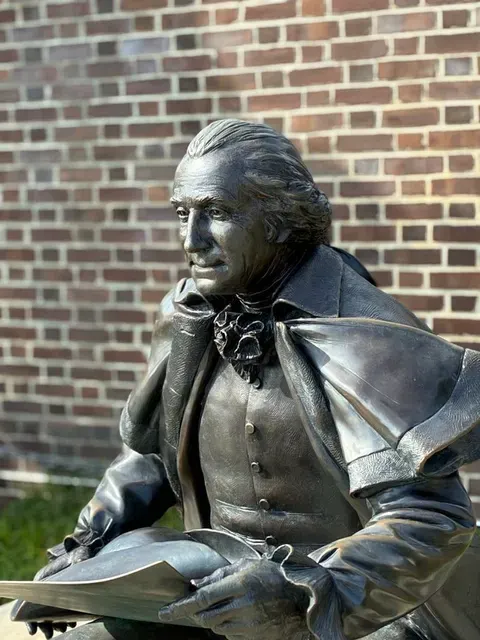
George Washington statue, American Revolution Museum at Yorktown.
The exhibit: a journey with context.
The layout.
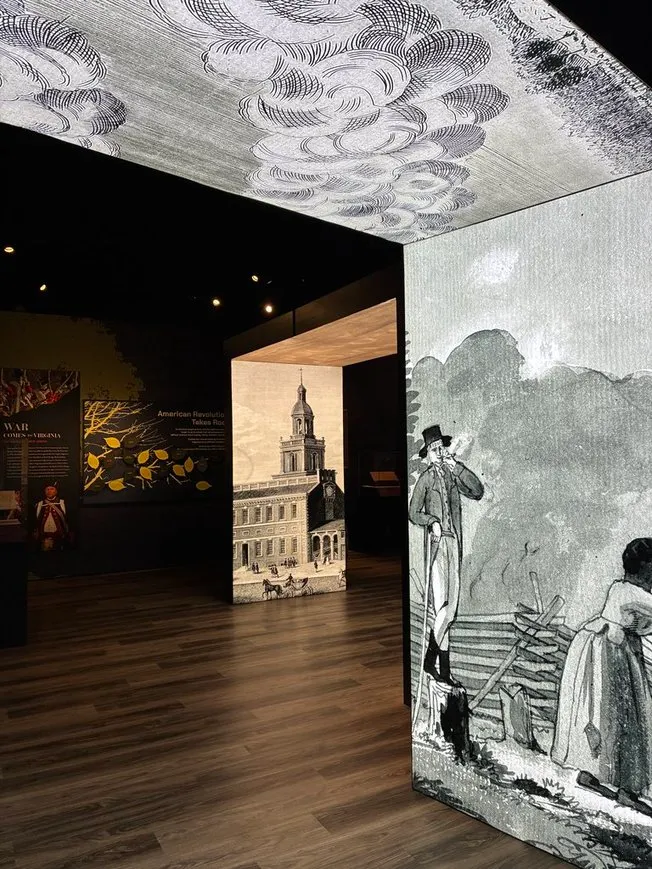
From the moment you walk up to the "Give Me Liberty" exhibit, the foundation is laid: it's about ALL the people who lived in 18th century America. Our shared history is clear.
Before you wander the portals of time into the roots of American Independence, you see images of Thomas Jefferson, Reverend Gowan Pamphlet (a man enslaved and active during the Revolutionary-era, who is freed in 1793), and a family at the dinner table.
Also- a prominent nod to Kishkalwa, Shawnee chief who, it's important to note, participated in the 1774 Battle of Point Pleasant during Dunmore's War. The Kishkalwa image is foreshadowing to what's included later in the exhibit, where you learn more about Dunmore and this renowned chief.
100% --- from the start you are immersed in the context of what Independence means -or could mean- across demographics.
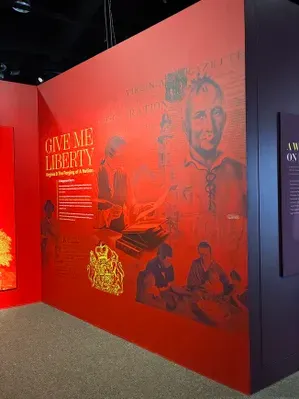
Graphic marking "Give Me Liberty" entrance.
Each section of time, every event, is done in progression. We wander through portals (similar to what the museum created for the Outlander exhibit I wrote about!).
And you do progress: through the years, the decades, all the way to recent history and beyond with hopes for the future. Through the portals with seeds of the liberty tree and emphasis on communication (the press!) from start to finish.
As a history-lover, I respect Curator Travis Henline and his team for pausing the idea of 1776 as the celebration date. The intentional arrangement urges the 'celebration' be grounded many moments.
Moments leading to a 33-year-old Jefferson picking up his quill at his traveling writing desk in a Philadelphia boarding house. Ultimately penning the words that continue to give Americans hope for the future. Sitting outside your home, in context of the theme of your writing, is something I can relate to Mr. J.
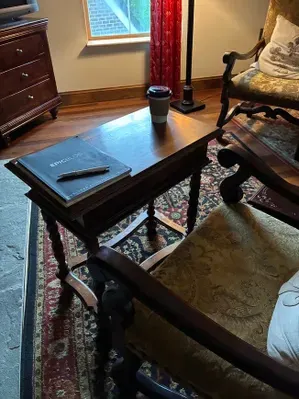
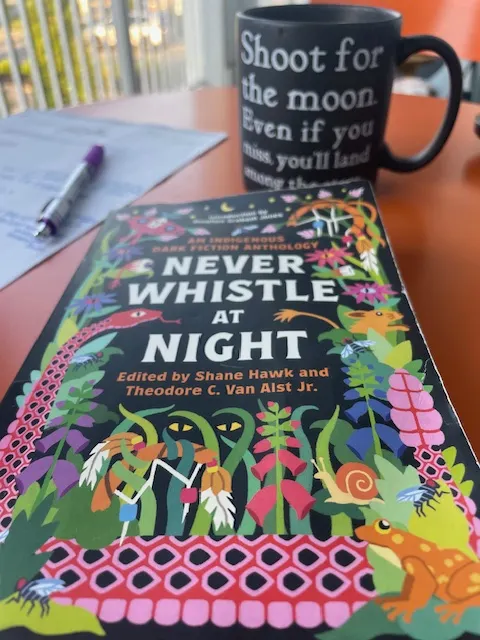
My desk on a history-blog workcation.
A special focus on the Seven Years' War (commonly referenced as the French and Indian War) marks the first deep-dive into the run-up to the summer of '76. Then on through the Yorktown Victory and beyond.
Standing before Charles Willson Peale's striking portrait of George Washington, you feel the strength of the man. You begin to understand the critical moments leading to 13 British Colonies declaring independence years later.
On loan from Washington & Lee University, this original of Washington speaks volumes. Painted in 1772, Washington chose to wear his uniform worn as Colonel in the Virginia Regiment, during the Seven Years' War.
From this impressive tour through the early years of our Revolutionary-era, through the battles fought in the taverns and on the landscape of early America, you'll find the value in knowing the vital role Virginia played in shaping the destiny of our United State.
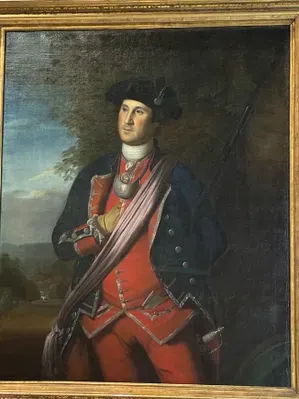
1772 Charles Willson Peale portrait.
The press theme woven through.
Taverns. Coffeehouses. Places where philosophical discussions of liberty and freedom were discussed. Also discussed there: letters, major events, accounts of what was happening throughout the newly-independent states.
From the Stamp Act Resolves introduced by Patrick Henry in the 1760s to the official printing of the Declaration, all of it passed colony to colony, then state to state, with help from early American newspapers and their printers.
In 1775, Williamsburg's Clementina Rind printed Jefferson's 'Summary View of the Rights of British America.' It was originally anonymous, but she added his name- cementing his reputation as one of the finest writers of his time. (and of all-time in my humble opinion)
Thus, the 'press' itself being woven through the "Give Me Liberty" exhibit. Beginning to end, including a massive reminder of the role newspapers played, but also of the importance of communication both then and now.
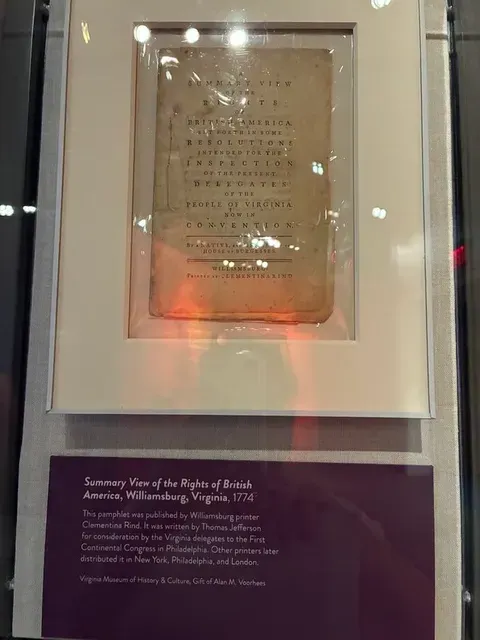
Printed 'Summary View' by Thomas Jefferson.
The thoughtful inclusion of objects.
From that first graphic showing all the people impacted, there are objects to represent them.
There are so many included with "Give Me Liberty" so in the interest of remembering this is a blog article and not a textbook, I'm sharing 5 that speak loudly of the value in objects to historical context.
- Patrick Henry's spectacles. You know- the ones perched on his head in Thomas Sully’s famous portrait.
- A reproduction of a "Liberty to Slaves" frock. Three words spoken loudly as the concept of liberty was spreading through America. Who wore this frock? According to the Virginia Museum of History and Culture (VMHC) we cannot be certain of the details. But...it is a relic of the past.
- Peter Force's 1833 printing of the Declaration of Independence from W.J. Stones' 1823 plate. Realization that original copies of the Declaration were fading, getting lost to time, etc. This plate was a way to preserve the words through time with newly printed documents.
- Virginia's Declaration of Rights- a rare copy! I won't lie: we have a framed reproduction of this document, primarily authored by George Mason the same summer Jefferson penned our Declaration.
- A surveyors compass. Dated about 1780, it's something that not only shares the story of surveying land for westward expansion, but to me, in this exhibit, symbolizes the earliest moments in finding direction for what would become our United States.
If you visit, please let me know what objects speak to you.
RELATED: Click here to read about the "Liberty for Slaves" frock, in a new tab, on the VMHC website, where it permanently resides. (currently on loan for the exhibit)
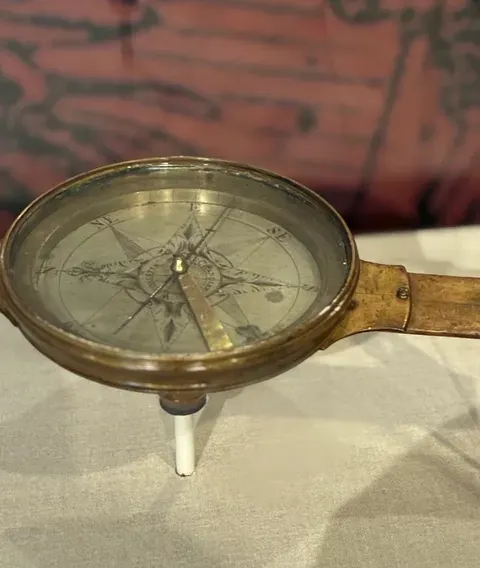
Surveyors compass, circa 1780.
3 highlights that stuck with me.
1) Reading Washington's words. I cannot get it out of my brain that a young Washington touched the paper on display.
Hearing so much about the movie "Young Washington" does give me hope that more interest will be taken in the Seven Years War.
The inclusion of this letter to Governor Dinwiddie in the "Give Me Liberty" exhibit is exceptional, driving home:
- that Washington was once young- and his experience with this war factored into the man he became later in life
- the importance of wartime communication through letters, and...
- setting the stage for our American Revolution.
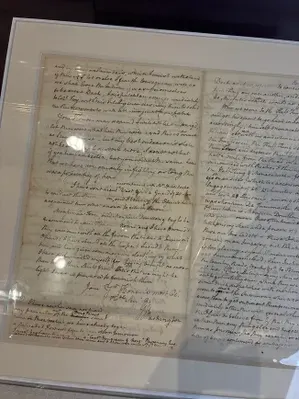
Washington letter.
2) The emphasis on shared history - everyone is not "represented." No- they were there, and are here in the exhibit. It's a natural inclusion. There's no forced moments in the "Give Me Liberty" exhibit.
The people, the thoughts, the objects, and art were all here in 18th century America. Walking through each portal and being exposed to every bit of it, feels right. There's no other way to describe it.
Dedicating one section to the "decisions.” Specifically, utilizing the stories of two Native American boys who attended the Brafferton Indian School in Williamsburg (on the campus of William & Mary). Robert Mursh, member of the Pamunkey, chose to fight in the Continental Army. Henry Bawbee, son of a Wyandot Chief, joined his father on the British side of the conflict.
You see a reproduction of the "Liberty to Slaves" frock. You watch a free (?) or enslaved (?) black man walking on the street in full-size imagery.
We don't know his status... and a visitor to Williamsburg or Yorktown in the 1770s wouldn't necessarily know.
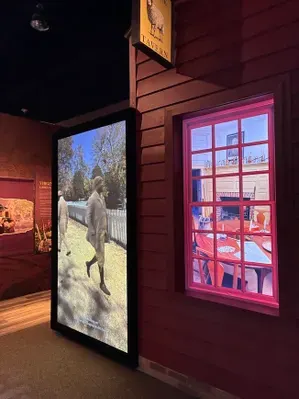
Image as part of exhibit experience.
3) The legacy and continuation of our American Revolution exists is fortified with the "Give Me Liberty" exhibit.
The subtle yet unmistakable detail of 'seeds of liberty' being planted throughout the "Give Me Liberty" exhibit stuck with me.
Planting your seeds (hopes, dreams, thoughts) as you exit the exhibit gives closure while reiterating the continuation of our American Revolution.
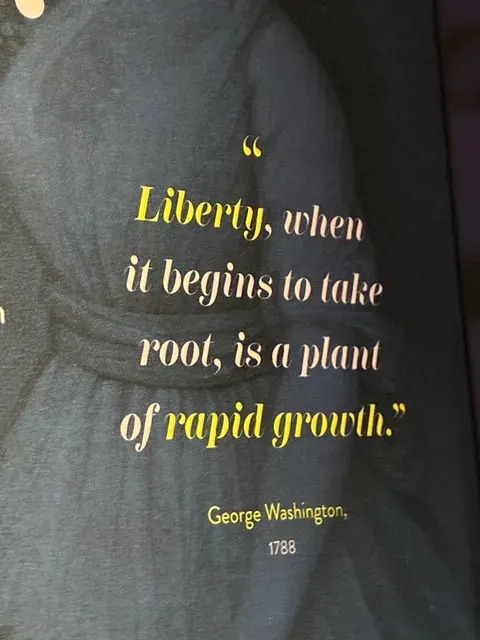
Quote displayed at "Give Me Liberty" exhibit.
2 Calls to action.
1) Stating the obvious: visit the "Give Me Liberty" at the American Revolution Museum at Yorktown. Get tickets here.
2) Book a call with me to discuss your trip to the area and purchasing a curated travel itinerary to sort your schedule! My goal: remove the stress of organizing your time and ensuring you don't miss the 'must-sees' like "Give Me Liberty!"
Closing words from history.
Below are a few excerpts from a 1755 letter to Governor Dinwiddie from Washington.
Click here to read it in full on my favorite site to read words from history: Founders Archives. Note: the numbers indicate citations/notes you can find on the link.
George Washington to Robert Dinwiddie, 8 October 1755
To Robert Dinwiddie
Fredericksburg Octr 8th 1755
Honble Sir
I arrived at this place in less than three hour’s after I wrote you from Colo. Baylors, and some small time after the arrival of Colo. Stephen who brings a worse acct than he related in his Letter; but as he is the bearer I shall be less prolix refering to him for paticular’s.1
I shall set out this Evening for Winchester where I expect to be join’d by the Recruits from Alexandria and this place (as soon as they can possibly march that distance) also by one hundd Men from Prince Willm and Frederik, 2 and I have wrote to Fairfax Coty desiring that a Troop of Horse may hold themselves in readiness to March at an hour’s warning,3 so that I doubt not but with the assistance of these I shall be able to repulse the Enemy if they are still committing their outrages on the Inhabitants.
We are at a loss for want of almost every necessary—Tents, Kettles, Arms, Ammunition, Cartridge Paper &ca &ca we are distress’d for, therefore I hope as your honour did not send to Philadelphia for them,4 you will if possible endeavour to get them below, and send them by the first oppertunity to this place or Alexandria with order’s that they may be forwarded immediately to Winchester.
(letter continues)
Are you enjoying this free blog? Use my online tip jar and buy me a coffee:

There is a huge practical disclaimer to the content on this blog, which is my way of sharing my excitement and basically journaling online.
1) I am not an academically trained historian. I will let you know I’m relaying the information as I understand and interpret it through my diligent research. The employees of Colonial Williamsburg base their presentations, work, and responses on historical documents and mainly primary sources.
2) I will update for accuracy as history is constant learning. If you have a question about accuracy, please ask me! I will get the answer from the best source I can find.
3) Photo credit to me, Daphne Reznik, for all photos in this post, unless otherwise credited! All photos are personal photos taken in public access locations or with specific permission.