When Virginia Lit the Flame: A 250th Anniversary in Colonial Williamsburg
When Virginia Lit the Flame: A 250th Anniversary in Colonial Williamsburg
May 19, 2026
I saw something monumental last night.
It was free and open to the public. It was fueled by donations, ticket sales, and passion.
Full stop and fast forward.
After typing the sentence above, I froze. I shut my laptop for 24 hours. And when I woke up today I realized something: sometimes there are no words and that's ok - because that in itself speaks volumes.
Letting this post (and my thoughts) settle from 'the morning after' into 24, and now 48, hours later was necesssary.
Flame of Revolution in Colonial Williamsburg (CW) was a one-weekend event.
An experience, not a 'show.'
Two nights of back-to-back performances honoring the 250th anniversary of Virginia's epic vote for Independence on May 15, 1776.
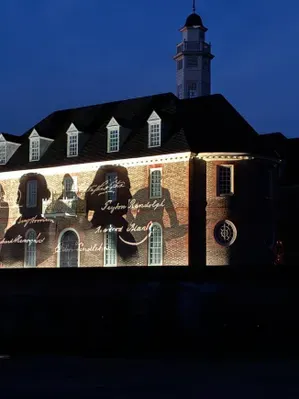
Projected image of Virginia statesmen
Words like epic and monumental barely scratch the surface in describing what co-authors and -directors Kurt Smith and Katharine Pittman brought to the world. Over a year of work culminating in 72 hours visible to the public.
Countless hours behind the scenes.
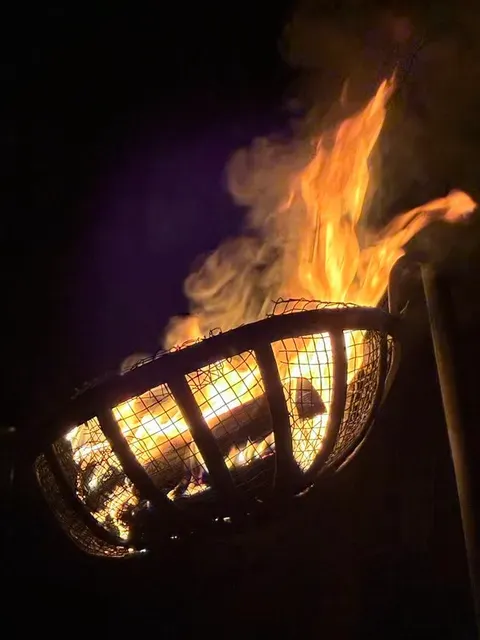
Broken down into a public rehearsal on the streets Thursday night followed by the two full-on performances, fireworks and all, Friday and Saturday nights. Complete with the scent of cressets and the undercurrent of Fifes and Drums.
RELATED: Click here to read about Kurt Smith and here for Katharine Pittman, CW's world-class historians portraying Thomas Jefferson and Martha Washington respectively.
Necessary disclaimer: As a blogger, I use affiliate links sometimes! I may receive commission from purchases I share; it does not change your price but sometimes you might get a discount.
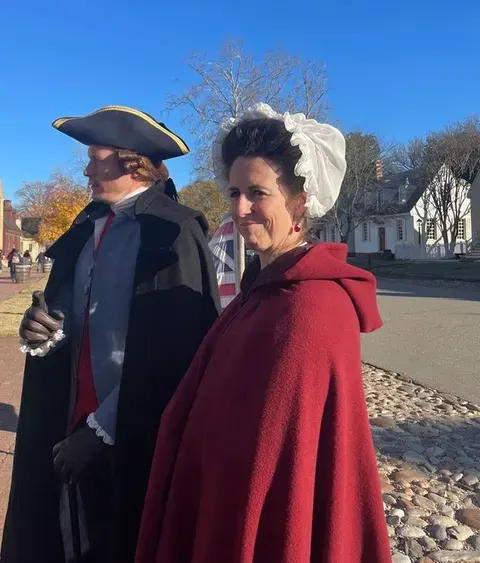
Kurt Smith & Katharine Pittman, Duke of Gloucester Street, CW
Flame of Revolution- the epic experience.
May 15, 1776 is a date to be remembered. Flame of Revolution honors it with something often missing in a world of AI, memes, and quick fixes on history: context.
Our Declaration of Independence wasn't a singular document.
It was the ultimate response to Virginia's May 15, 1776 resolution and instruction to her Philadelphia Congressional delegates to put Independence to a vote. And to all the 'moments' of rising concern and tension going back over a decade.
Flame of Revolution opened with a re-enactment of President Franklin Delano Roosevelt's (FDR's) 1934 honorific visit to CW and 'opening' the Duke of Gloucester Street as what he calls: "the most historic avenue in America."
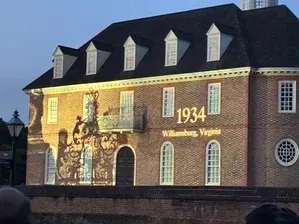
Backdrop for FDR visit.
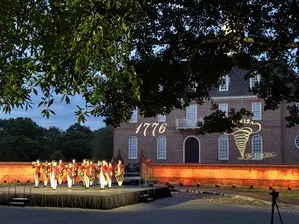
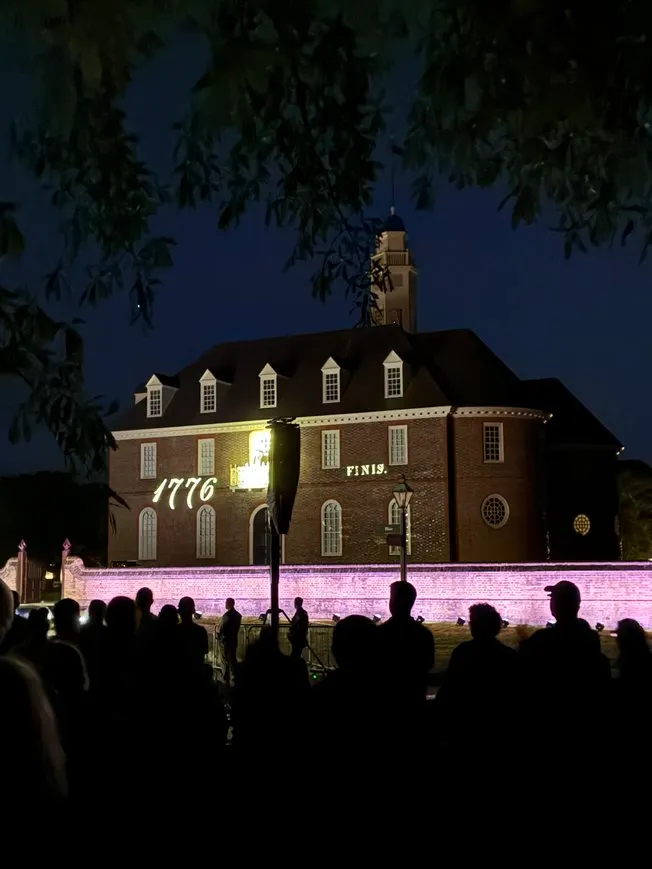
In the darkness of CW, the restored Capitol Building became the commanding backdrop of the evening. Once again, I'm at a loss for words- the emotion evoked through projection of images and words was mind-blowing.
As performers took to the stage, the year of each event showed up on the Capitol.
As compelling narration transpired by both Bill Barker and Richard Schumann, legendary historians and interpreters of CW, images and words kept us all captivated on the building.
And the brilliance, both bold and subtle, of Smith's and Pittman's arresting writing took hold.
- subtle: Peyton Randolph portrayed by CW's George Washington, Ron Carnegie, frozen on stage as narration explains his early death --- death preventing him from seeing the result of his leadership both in Virginia as Speaker of the House and in Philadelphia as President of the Continental Congress
- subtle: the names of enslaved projected on the Capitol Building after a heart-wrenching two-person performance of a lifelong friendship between an enslaved black woman and a white woman; topic: a brilliant analogy relating the actions of cicadas in the context of running TO freedom
- bold: the screams, shouts, and shrieks of dozens of CW interpreters and tradespeople immersed in the defining moments of Williamsburg, where it feels obvious to me, the flame of Revolution was sparked
- bold: the passion of Richard Henry Lee, who introduced the document for Independence in Philadelphia on June 7, 1776; the one adopted on July 2nd
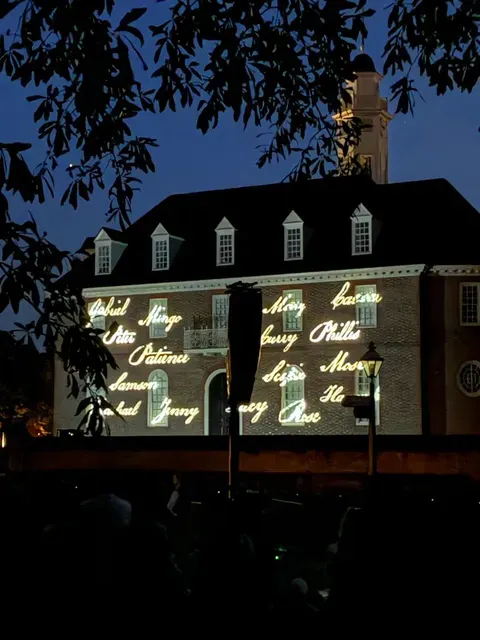
Projected names of the enslaved.
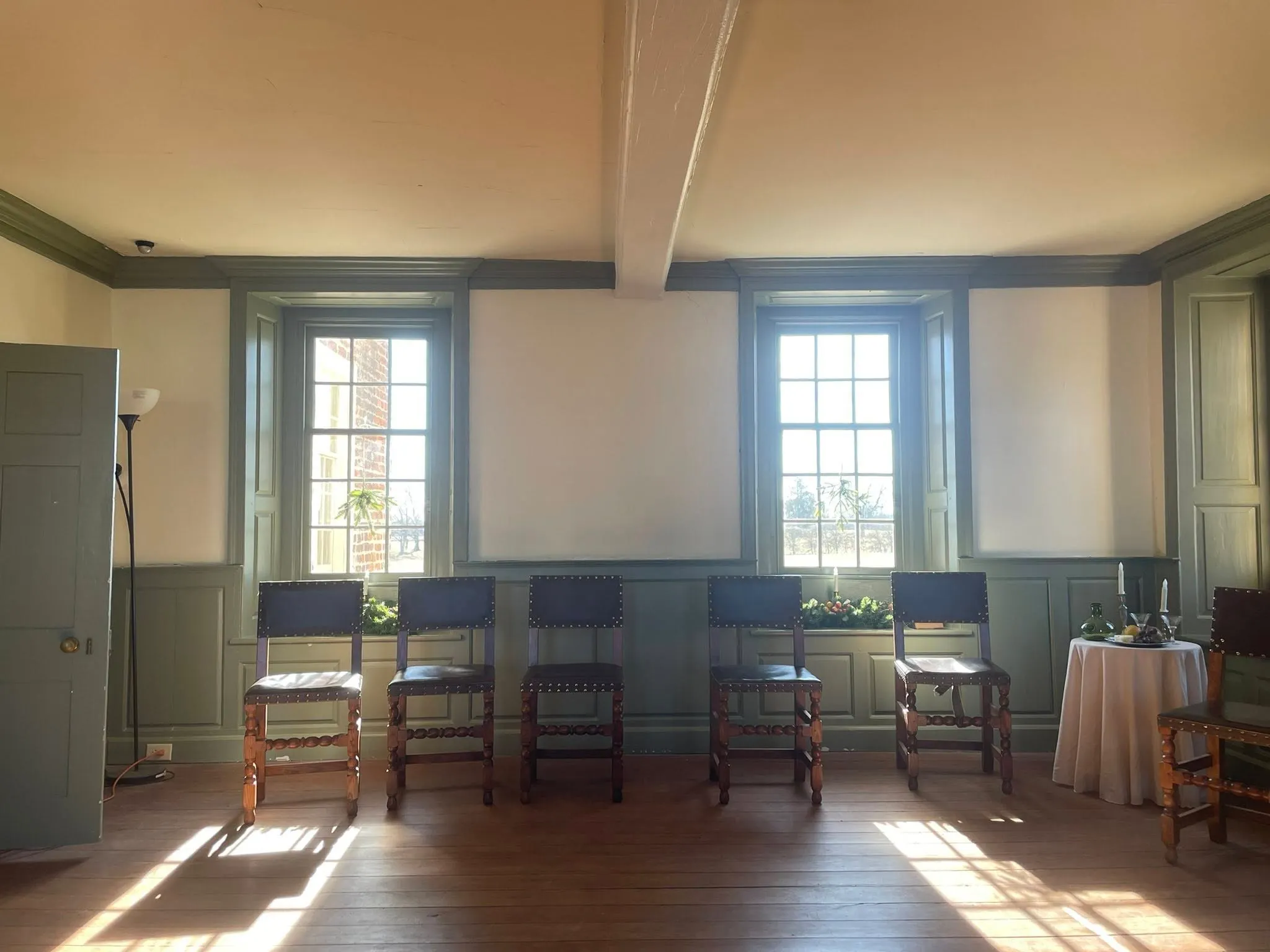
I wouldn't have understood all of the nuance I could conjure in my mind, had I not gone to CW's St. George Tucker House to meet in small group for a visit with Thomas Jefferson- and Kurt Smith.
To name a few:
- the underscore of music defining the moments (for which Wayne Hill is the mastermind)
- hundreds of newspapers’ reports of FDR's visit to intertwine primary-sourced research and Richard Schumann's words echoing through CW
- use of Virginia Gazettes to accurately display the the names of enslaved men and women who took Lord Dunmore up on his offer for freedom
- every wig fitted with painstaking detail and commitment to perfection by Master Wigmaker Debbie Turpin, and her team including our friends Edith, Benton, and Eli
- the digital expertise in creating a perfect backdrop for every story, every aspect of Flame of Revolution
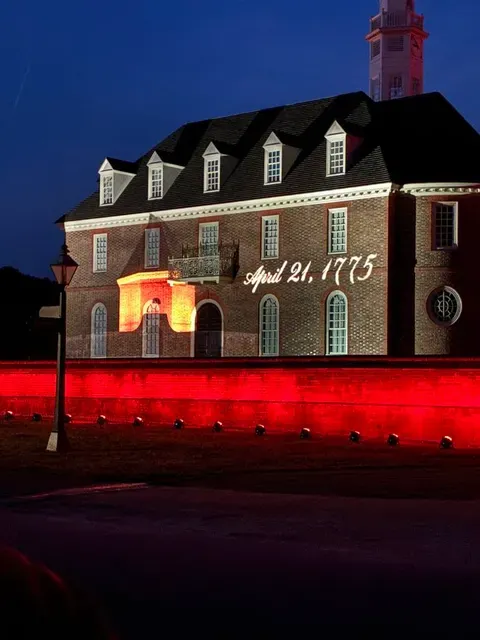
Experience 250 for yourself.
Timing isn't everything. Even though Flame of Revolution is in the past (for now?), this post is what we call 'evergreen' online. We can always be inspired.
Find history everywhere. Find history anytime.
For 250th-specific events, open America250.org in a new tab. Search out events in your state or any state you visit.
See something epic. Be a part of something monumental. Make a point of experiencing it in person- smell the cressets, hear the drumbeat.
And then: dig deeper into the past. Attending Flame of Revolution (I hope!) will inspire thousands of people, if not tens of thousands through the ripple effect, to honor May 15, 1776.
- Inspire research into Dunmore's Proclamation and the impact on both enslaved and free people who lived in America during the Revolutionary era.
- Imprint names like Peyton Randolph, Richard Henry Lee, and Lord Dunmore into our individual as well as collective memories-- right along with Patrick Henry and George Washington.
- Understand the context of the actions leading to our Declaration of Independence and the men who signed it, their families, and their legacies.
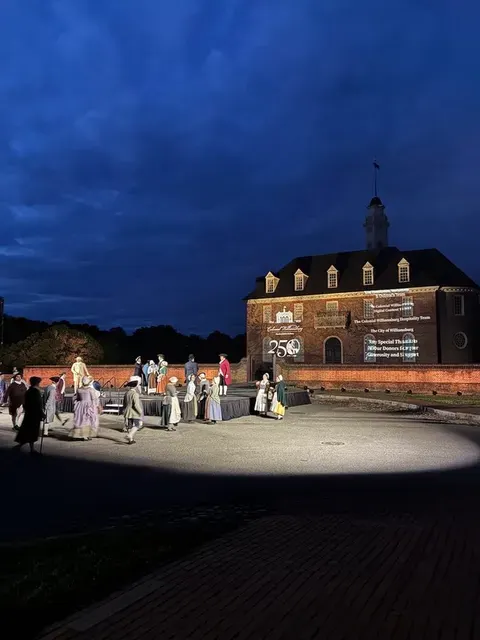
Rehearsal, Flame of Revolution
Experience Colonial Williamsburg.
Come visit us here. Get tickets to CW. Meet the historians, ask questions.
Book a call with me and let's explore what FDR proclaimed the "most historic avenue in America" together.
Go further-- let me put together an itinerary for your trip - and yes, that can include a free tour around the historic area.
Be inspired in the place where America was made: Virginia. Specifically: Williamsburg.
Closing words from history.
From George Washington, who was in Philadelphia May of 1776, while his younger brother John Augustine was in Williamsburg. Below is an excerpt of a letter to John Augustine- responding to the news from Williamsburg.
Our first commander-in-chief relates his thoughts on the impact to those in Congress who still looked towards reconcilitation as an option.
Click here to read the letter in full, with notes and citations, on Founders' Archives.
George Washington to John Augustine Washington, 31 May–4 June 1776
To John Augustine Washington
Philadelphia May 31st[–4 June] 1776
Dear Brother,
Since my arrival at this place, where I came at the request of Congress, to settle some matters relative to the ensuing Campaign I have received your Letter of the 18th from Williamsburg,1 & think I stand indebted to you for another, which came to hand sometime ago, in New York.
I am very glad to find that the Virginia Convention have passed so noble a vote, with so much unanimity2—things have come to that pass now, as to convince us, that we have nothing more to expect from the justice of G: Britain—also, that She is capable of the most delusive Arts; for I am satisfied that no Commissioners ever were design’d, except Hessians & other Foreigners;3 and that the Idea was only to deceive, & throw us off our guard—the first it has too effectually accomplished, as many Members of Congress, in short, the representation of whole Provences, are still feeding themselves upon the dainty food of reconciliation;
Are you enjoying this free blog? Keep me caffeinated, researching, and writing! Use my online tip jar to buy me a coffee:

There is a huge practical disclaimer to the content on this blog, which is my way of sharing my excitement and basically journaling online.
1) I am not a historian nor an expert. I will let you know I’m relaying the information as I understand and interpret it. The employees of Colonial Williamsburg base their presentations, work, and responses on historical documents and mainly primary sources.
2) I will update for accuracy as history is constant learning. If you have a question about accuracy, please ask me! I will get the answer from the best source I can find.
3) Photo credit to me, Daphne Reznik, for all photos in this post, unless otherwise credited! All photos are personal photos taken in public access locations or with specific permission.