Restoring Bacon's Castle in a Year Commemorating 350 Years Since Bacon's Rebellion
Restoring Bacon's Castle in a Year Commemorating 350 Years Since Bacon's Rebellion
Feb 23, 2026
I'm not a math and science gal: but there's relevance for history lovers.
Us history lovers, we want to immerse ourselves in the past; it's a solid reason to visit historic sites. We want to see the finished (restored) product and wander through it. Right?
Absolutely.
However, when I visited Bacon's Castle a few weeks back, Director of Architecture for Preservation Virginia, Eric Litchford, dropped a seemingly simple phrase that weighed heavy: "preservation before restoration."
Eric's a Virginian- he studied at Mary Washington University and the passion and expertise he brings to his role at Preservation Virginia is contagious. I want to give him a big shout-out and thank you!
So let's get to it. Math, science - my weaknesses but with Eric's guidance: fascinating.
Here we go! A few projects happening in 2026 at Bacon's Castle, the inspirations (rabbit holes!) I began musing on, and of course: a few calls to action before closing words from history.
RELATED: Click here to learn about Preservation Virginia by opening a new tab.
Disclaimer: As a blogger, I use affiliate links sometimes! I may receive commission from purchases I share; it does not change your price but sometimes you might get a discount.
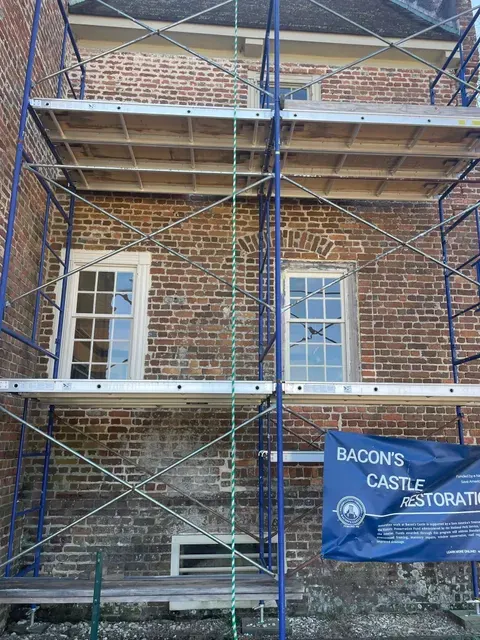
Rear of Bacon's Castle, January 2026.
Projects happening at Bacon's Castle.
What's so cool about the projects taking place at Bacon's Castle in 2026?
As Eric stated (and educated me on through our tour): "It's the only place you can watch change happen from the 17th century to the present."
Some of you may know I've written about Bacon's Castle in the past. I'm compelled to add to the list of learnings I've acquired on what's the oldest recorded brick dwelling in the United States.
This fact about the structure in itself is potent, is it not? Therefore, it's with certainty, recognizing and grasping the importance of Bacon's Castle preservation projects is vital to me.
RELATED: Click here for insight into the history of the property and the people who lived there; it will open into a new tab.
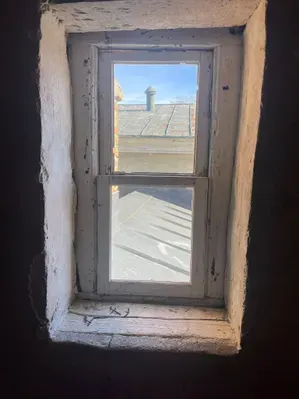
Casement window, top floor.
In the spirit of preservation first: fire suppression.
Compliance doesn't ensure a long life. Yes, the halon gas fire suppression system put in at Bacon's Castle in the 1970s was code compliant. However, Eric explained the significance of utilizing the latest technology in preserving this 17th century building.
The new technology, which will replace the hard-to-find halon gas is a high-pressure mist system that runs on tanks. The idea is "suffocating" vs. "dousing."
Threat of fire is something I admit I rarely think about. Which makes no sense as much as fire destruction is mentioned when touring historic sites, visiting museums, and reading about historic events.
This is a perfect example of stabilization, prevention, and preservation taking a front seat at Bacon's Castle.
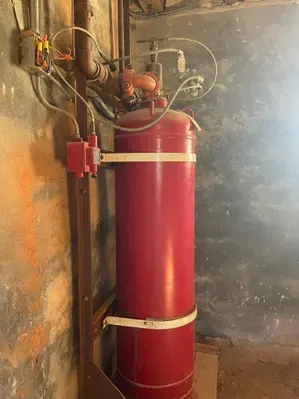
Fire suppression system.
Century to century: windows and casements.
With 68 windows at Bacon's Castle, preserving and protecting them is a vast task. And also: a priority.
The casement windows in the attic are a rarity and it's a privilege to get up close and personal with them. Surely, standing in front of one, it's easy to think about who spent time in the space, and what they may have felt looking out into the world.
All 68 windows at Bacon's Castle show movement through three centuries; as Eric pointed out: it's a building where you can watch change happen, and extrapolate it to humans who walked the floorboards.
Architecturally, each century is defined by the windows.
- 17th century- an opening
- 18th century- a frame
- 19th century- trim
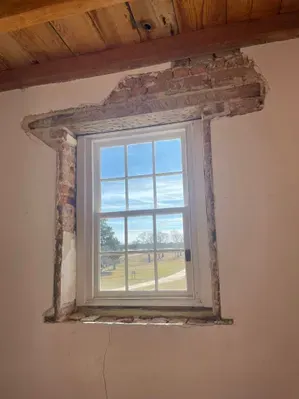
Window displaying evolution of features, 2026.
Keeping it dry: drainage.
It doesn't sound sexy: designing and building underground drainage systems. But ensuring everything is waterproofed and operating effectively... as critical as the paint chosen for the walls.
Reminder: Bacon's Castle is a brick building. And since brick is porous, efforts to keep the building water-tight and dry are crucial to the future of this historic site.
On the topic of those bricks, technology was (is!) vital. As work was done to replace bricks, technology identified materials to ensure anything new lived cohesively with the old.
Knowing the materials as well as the process ensured masonry and mortar were authentic and effective.
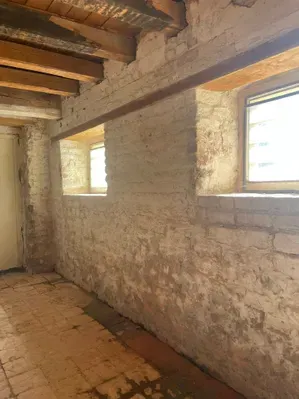
Lower level, January 2026.
Evolving through centuries: floorboards.
The windows are clear architectural indicators of century-to-century updates. But also... floorboards at Bacon's Castle offer a clear image of the structure's evolution.
Hints to the age of the materials, the work in both creation and repair of the floorboards: visible.
Diving into the floorboards from the perspective of Eric and his team is about "assess[ing] the stability of the timber connection and determin[ing] whether the earlier metal reinforcement is functioning properly."
From the numbers marking the planks to the whitewash utilized in the 18th century, historians and architects can glean information not only for preservation purposes, but to share with interpreters for educational purposes.
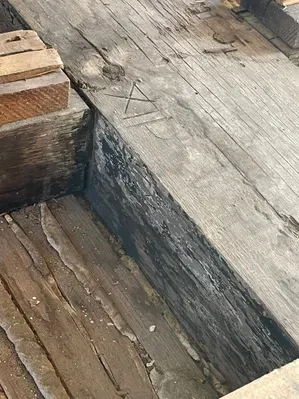
View of open floor, January 2026.
Important for all these changes: recording the work. Not just in logbooks, papers part of a trail, or online. Marking the objects leaves solid clues for future historians, architects, and preservationists.
The window below is engraved with "2025" so there's no confusion as when this important update was made to Bacon's Castle.
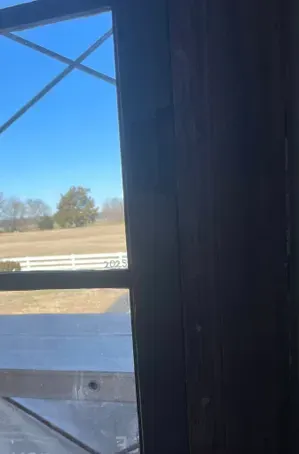
Window marking, 2025.
Two topics inspired by my time at Bacon's Castle:
1) Chesapeake Architecture
On the lighter side before I get to number 2, I'm loving a side chat Eric and I had about Chesapeake Architecture. It's special (not just because I live here, I promise!).
I've had the honor of learning about it in Colonial Williamsburg's (CW's) Carpenter's Yard.
Conceptually, it's simple really. But for someone who doesn't think about it unless it's pointed out, it's new of course! Truly, this type of architecture is based on practicality for the region.
Chesapeake Architecture:
- is found in many CW homes, throughout this part of Virginia, Maryland, and even into North Carolina
- features include a central entryway, instead of a hallway, connecting front and back entrances (this is meant to improve airflow in an area that is hit hard with summer heat and humidity)
- boasts a stairway that "turns," with rooms to the left and right at the landing
But learning about uniqueness of local architecture piques my interest beyond the Chesapeake region. Please share any tidbits about your regional architecture in the comments or by messaging me using Instagram!
RELATED: "The Chesapeake House" dives into Chesapeake Architecture. It's a book recommended to me by the carpenters of CW.
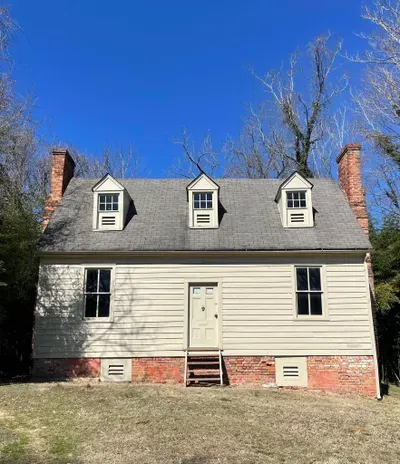
Booker Tenement, Chesapeake Architectural example.
2) Developmental pressures.
Bacon's Castle is in the competent and caring hands of Preservation Virginia. And I love that for this historic site. However: I fear developmental pressures erasing history in other places. There, I said it.
History is really what happened moments ago, is it not? So what about buildings built this year, last decade, last century? Or "abandoned" buildings and properties owned by "estates" not individuals... sites ripe for "sale" in order to build, build, build.
Yes, friends, I fear that history is being lost to developmental pressures for "new" to come in. My ask: think about this when your city council or planning commission or zoning or whoever makes a move.
I'm not saying there's no room for development, just that preservation of our shared American history deserves a voice at the table. It's how development is approached in my humble opinion.
New and old side by side can be cool. Architecture tells stories. My ask to the world, don't forfeit the past for the sake of the future. Bring it all together instead.
On a recent visit to Richmond, Virginia, we got a visual of this concept. Old and "new" can co-exist like the Old City Hall reflected in the Virginia Commonwealth University (VCU) Children's Hospital building as pointed out to us by my friend and Executive Mansion Historian and Deputy Butler, Martin Townes.
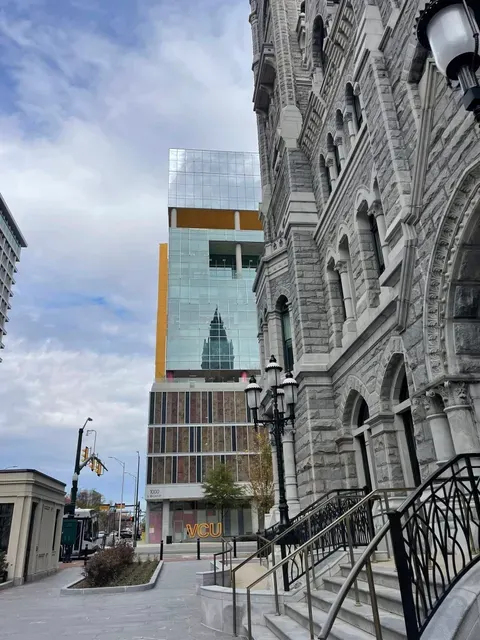
Old City Hall reflected on VCU Children's Hospital at Richmond.
If you want to learn more about about Bacon's Castle:
Visit Bacon's Castle.
Click here to be re-directed to their website where you can purchase tickets.
Keep watch for events related to the 350th anniversary of Bacon's Rebellion, including their lecture series.
Want to know more about Bacon's Rebellion?
Preservation Virginia is not only scheduling events throughout the year, but they've offered us a dedicated webpage for this monumental anniversary.
And let me know if you do register for any of the events! I hope to see you there.
Book a call, get your trip organized.
I love sharing the restoration and preservation efforts in Colonial Williamsburg, and around it.
I can get you on-track for a trip focused on the history you love.
Click here to discuss --- especially if you want to hear about how I can create a travel itinerary for you; because I guarantee Bacon's Castle, as well as other Preservation Virginia sites, can be on a curated itinerary you purchase.
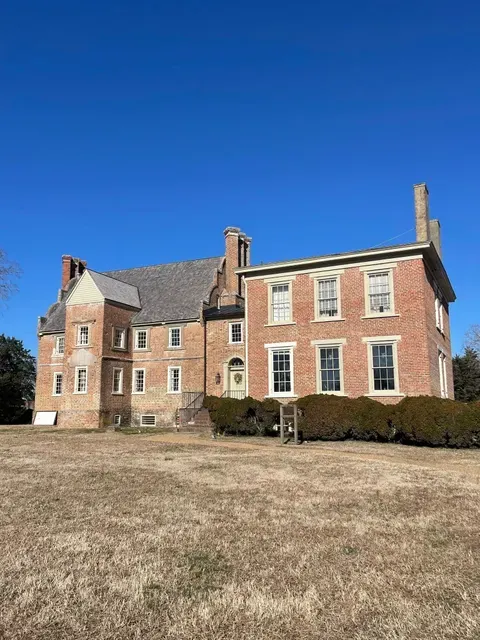
Bacon's Castle, January 2026
Closing words from history.
I'm choosing a different bit of "closing words" this time.
For me, the decision of Preservation Virginia to create a mission statement and share their vision keeping the organization focused on preservation before restoration, is important to share on my blog.
What began over 100 years ago as the Association for the Preservation of Virginia Antiquities, has evolved into a relevant and vital entity. The projects happening at Bacon's Castle are a few pieces of a vast puzzle.
Pulled directly from Preservation Virginia's website:
"Mission
Our mission is to inspire and engage the public in fostering, supporting and sustaining Virginia’s historic places through leadership in advocacy, education, revitalization and stewardship.
Vision
We envision a future in which people seek a more complete understanding of the past, value the connections between people and place and support the protection of places where history happened."
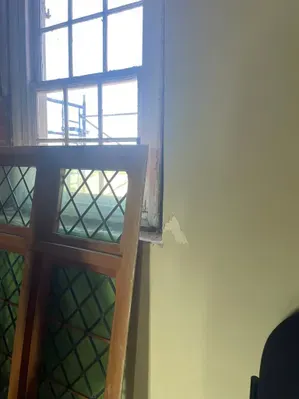
Upstairs window, 2026.
Are you enjoying the blog? Use my online tip jar and buy me a coffee:

There is a huge practical disclaimer to the content on this blog, which is my way of sharing my excitement and basically journaling online.
1) I am not a historian nor an expert. I will let you know I’m relaying the information as I understand and interpret it. The employees of Colonial Williamsburg base their presentations, work, and responses on historical documents and mainly primary sources.
2) I will update for accuracy as history is constant learning. If you have a question about accuracy, please ask me! I will get the answer from the best source I can find.
3) Photo credit to me, Daphne Reznik, for all photos in this post, unless otherwise credited! All photos are personal photos taken in public access locations or with specific permission.