Quiet Courage: Faith and Freedom in Tracy Chevalier’s The Last Runaway
Quiet Courage: Faith and Freedom in Tracy Chevalier’s The Last Runaway
Jun 19, 2026
Running to 1850 Ohio.
If you're on my email list, you might have picked up on my love for reading. Letters are my favorite primary source, letters in books: pure gold. I haven't found a book containing letters from the past that's bored me.
But there's another way to soak in the past through books: historical fiction, one of my two favorite fiction genres. When I want to run away into the past, especially a period and a place I'm not super-familiar with, what better way?
That said, I'm picky. I start a lot of books but when it's historical fiction, it's easy for me to get distracted - is it accurate, is it believable... but sometimes, I just get lost in the book.
That's when you see me recommending it.
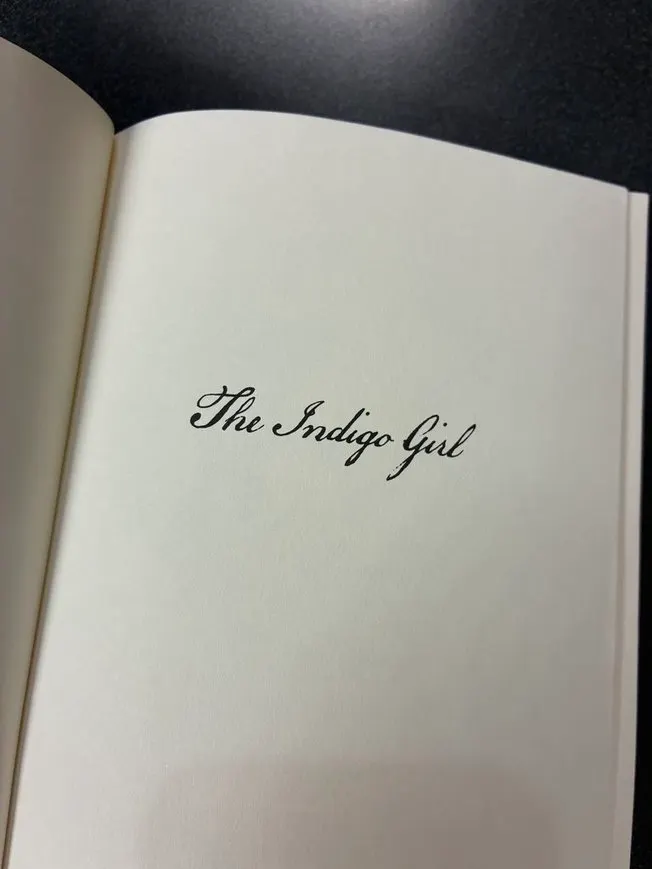
In a year filled with 250th celebrations, on a blog with a whole lot of 18th century content, I decided to escape to 1850 Ohio. The Last Runaway by Tracy Chevalier was recommended to me and having grown up in the Midwest, I couldn't resist.
RELATED: Click here to open my 'books' category in a new tab.
Necessary disclaimer: As a blogger, I use affiliate links sometimes! I may receive commission from purchases I share; it does not change your price but sometimes you might get a discount.
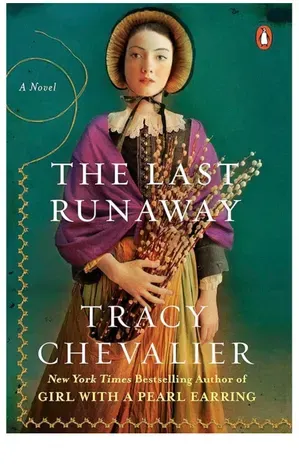
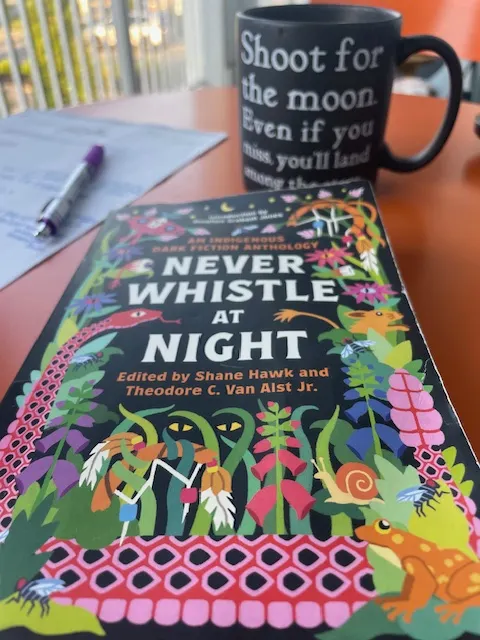
Kindle book cover, The Last Runaway
Who should read The Last Runaway?
Loving to learn about history is a given. Anyone who does will appreciate The Last Runaway.
But drilling it down further- readers partial to any of the following should read it:
- curiosity about those who emigrated from England, ripe with history, to a new-found nation finding its footing
- understanding the Quaker communities settled in the American Midwest
- Ohio's developing role in the 'Underground Railroad'
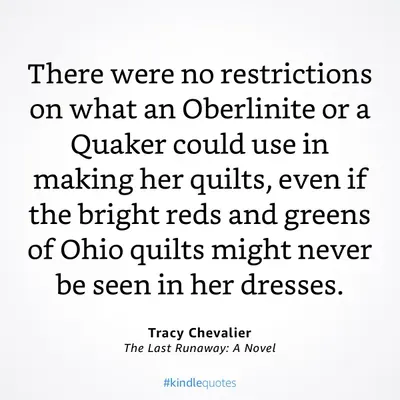
- quilting - the textiles, the social opportunities, and of course: the cultural distinctions between America and England
- millinery- especially those with a love for 19th century bonnets
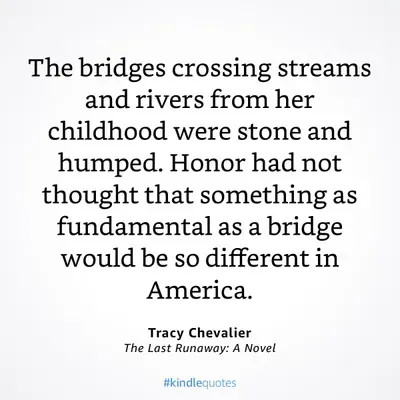
The basis of the book.
I gave a hint to the book's basis in my first bullet point above. The foundational story is a young woman named Honor, jilted and ashamed, emigrating to the United States at the first opportunity she has.
Honor's sister Grace is to be wed in Ohio and both women are seeking a new life, still in the Quaker community, but across an ocean.
While in America, Honor discovers herself. She's both flustered and fascinated by the land, the people, and the political climate in her new country. In The Last Runaway, author Tracy Chevalier knowingly or unintentionally leaves interpretation of the title to the reader; either way, I find the title brilliant.
Starting in 1850, this book weaves Honor's commitment to her Quaker community and practices with actions and thoughts that shift her perspective. Or at the least, force her to justify decisions.
What is right vs. legal vs. practical. On the eve of the Civil War.
This book is insight into the Quaker faith in conflict and in support of true freedom.
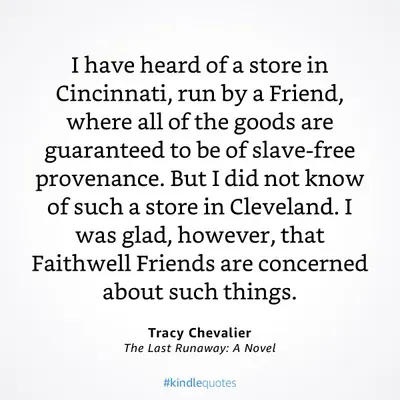
A writing style that shifts your mindset.
Don't let my synopsis of The Last Runaway leave you thinking this book feels deep. It is, but it's hardly a textbook. It's 100% novel.
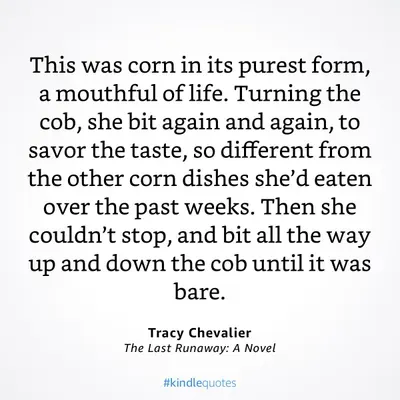
Chevalier's writing style immerses you in mid 19th-century Ohio. You taste the sweet corn right off the cob, you smell the spicy cooking of a free black woman whose food matches her will, you hear the heavy approaching hooves of a horse ridden by a 'slave-catcher' making every breath a hidden runaway takes palpable to us as readers.
But then: by the end of the book, you realize your mindset has shifted. Whether it's about the settlers and residents of Ohio's torn patriotism, or the difficult decisions each character must make, your mind is digging deeper than a typical novel invites.
The Last Runaway offers the chance to dive into history without feeling like you're being lectured. It's simply humans creating a life for themselves in an environment that lends itself to a fantastic story.
As my dear friend Jean kindly said of this blog, I'll say of Chevalier's writing: "learning history always felt eating my vegetables but your writing makes it feel like dessert." (thanks Jean!)
Buy the book.
If you love American history, this is another must-have for your historical fiction collection. It's tiramisu on a buffet of broccoli and brussels sprouts. It's the leadup to the Civil War every historical fiction lover needs to read.
Buy The Last Runaway by clicking here.
Oh- and what's the other of my two favorite fiction genres? Freida McFadden. I know- she's an author, not a genre.
To explain: the same way Gen Z gets '6 7' a whole lot of readers out there get 'Freida.' Anything Freida-esque -- solidly written mystery/thrillers with brilliant twists and sickeningly relatable wit is a book I'll devour.
RELATED: Click here to see more book recommendations on my Amazon storefront!
Closing words from history
From Abraham Lincoln's 1849 bill proposed to abolish slavery; this section showing the complexity of the issue around the time of Honor's emigration to America.
Section 4 of Lincoln's bill discusses payment by the government to slave-holders in order to free the men and women they enslave.
To read the full bill, click here and open the Library of Congress' website in a new tab. For ease of reading, I've broken one paragraph into four. Otherwise, I haven't altered the writing.
Section 4. That all persons now within said District lawfully held as slaves, or now owned byany person or persons now resident within said District, shall remain such, at the will of theirrespective owners, their heirs and legal representatives:
Provided that any such owner, or his legal representative, may at any time receive from the treasury of the United States the full value of his or her slave, of the class in this section mentioned, upon which such slave shall be forthwith and forever free:
and provided further that the President of the United States, the Secretary of State, and the Secretary of the Treasury shall be a board for determining the value of such slaves as their owners may desire to emancipate under this section; and whose duty it shall be to hold a session for the the purpose, on the first monday of each calender month; to receive all applications;
and,on satisfactory evidence in each case, that the person presented for valuation, is a slave, and of theclass in this section mentioned, and is owned by the applicant, shall value such slave at his or her fullcash value, and give to the applicant an order on the treasury for the amount; and also to such slavea certificate of freedom—
----
Are you enjoying this free blog? Use my online tip jar and buy me a coffee:

There is a huge practical disclaimer to the content on this blog, which is my way of sharing my excitement and basically journaling online.
1) I am not a historian nor an expert. I will let you know I’m relaying the information as I understand and interpret it. The employees of Colonial Williamsburg base their presentations, work, and responses on historical documents and mainly primary sources.
2) I will update for accuracy as history is constant learning. If you have a question about accuracy, please ask me! I will get the answer from the best source I can find.
3) Photo credit to me, Daphne Reznik, for all photos in this post, unless otherwise credited! All photos are personal photos taken in public access locations or with specific permission.