Sadeqa Johnson’s Yellow Wife Reviewed: Insight into the Slave Trade and Virginia’s Antebellum World
Sadeqa Johnson’s Yellow Wife Reviewed: Insight into the Slave Trade and Virginia’s Antebellum World
Mar 08, 2026
I can’t remember why I grabbed Yellow Wife off the shelf.
Book recommendation? Historical fiction group online? Searching Goodreads? No clue. But I grabbed a copy of Yellow Wife. And in return, author Sadeqa Johnson, whose experience as a history lover living in Richmond Virginia, grabbed me back with her words.
Exploring the Richmond Slave Trail with her family, Ms. Johnson was inspired to dig deeper. The result being a rabbit hole highlighting one of the most well-known families of mid 19th-century Richmond.
I connected with Ms. Johnson immediately. As a history lover, her reaction to her research, evident in the bit of her book dedication mentioning her children, cemented my respect for this author.
Yellow Wife is a book of historical fiction firmly grounded in fact.
So while I don’t recall what brought me to Yellow Wife, here’s what I do know: I’m better for reading this book. And I wholeheartedly recommend it. If you want to know why, keep reading.
Necessary disclaimer: As a blogger, I use affiliate links sometimes! I may receive commission from purchases I share; it does not change your price but sometimes you might get a discount.
And if you’re ready to jump in and buy it, click here.
RELATED: Click here to open more detail about the Richmond Slave Trail in a new tab.
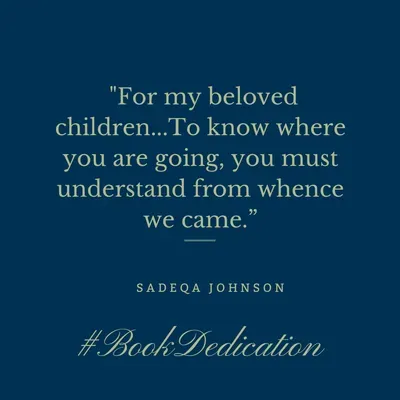
Excerpt of Johnson's book dedication.
Book citation: Yellow Wife by Sadeqa Johnson, © 2021, published by Simon & Schuster, New York.
Who should read Yellow Wife?
It’s harsh, grounded in reality. So should younger readers jump on board? This is one I’d recommend parents read first and make the decision. Adult themes, violence. It’s in there… as you’d expect from a book built around the story of a woman whose experience includes being enslaved.
It is heavy. But for those seeking insight into life at the heart of the slave trade in 19th century Virginia: it’s a must-read.
Because of what I’ll term the “readability factors,” Yellow Wife can indulge a wide audience. What do I mean by readability? I’m explaining that through the next two sections.
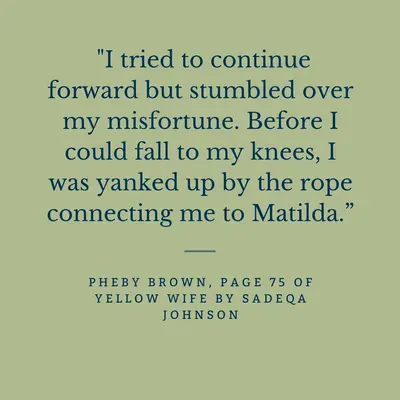
Journey to Richmond's Devil's Half Acre.
Readability factor 1: fact into fiction with a plot that resonates.
I’m ridiculously picky, bordering judgmental, when it comes to books set in an historic period. Whether it's historical fiction like Yellow Wife, or biographical and other non-fiction. If you’ve read my past book reviews, you’re fully aware of this.
Sadeqa Johnson had me hitting Google. But only after I read her book. I admittedly have limited knowledge of the Virginia slave trade, but living in the area and researching our shared history has given me a deeper understanding than what I had living in Michigan.
Reading Elizabeth Keckley’s book Behind the Scenes OR Thirty Years a Slave and Four Years in the White House, drew a picture of the era. Of the humans who lived it. And Ms. Johnson’s vision didn’t have me wavering or stepping away.
The plot is fascinating. An enslaved girl on the edge of becoming a woman, is sent to auction and falls into the life of “mistress” of one of the most “successful” (ICK) jails in Richmond. This main character, Pheby Brown of Charles City, is based on Mary Lumpkin and the Jailer Lapier on her real-life husband Robert.
And when I finished, I hit Google. It’s where I learned the fate of both Robert Lumpkin and Mary, the formerly enslaved girl who ultimately became his wife.
Click here to learn about the Lumpkins of Richmond, including Mary’s legacy, on the Smithsonian Magazine’s website (or wait until after you read Yellow Wife and then come back!). But do read the article!
RELATED: My post about Elizabeth Keckley’s memoir.
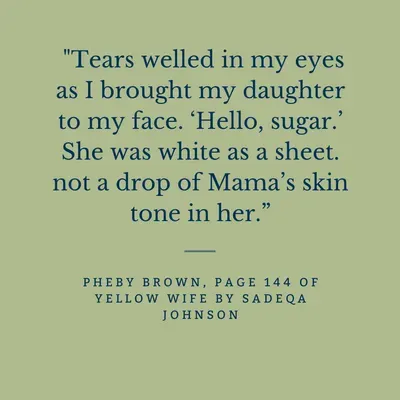
Pheby greeting her eldest daughter into the world.
Readability factor 2: a writing style that’s effortless (for the reader).
As someone who values authentic writing, connecting with readers, and creating formats that flow when talking about history, I find Ms. Johnson’s extensive skill unmistakable.
This author uses her pen to paint a portrait of life at the infamous Devil’s Half Acre, where the Lumpkins lived and worked. The colors she uses dance around the spectrum. From the deepest black to misty gray to bright moments enveloped in pinks and purples.
Violence and fear, as well as love and strength, manifest through characters like Pheby’s true love Essex, her children, and relationships with other Richmond slave-traders and jailors and their mistresses. She drops actual names from history.
Also: the complexity of life in 19th century America, going beyond the borders of Virginia through discussions of escape and attendance at Northern schools, is tangible.
Yellow Wife progresses, chapter-by-chapter and year-to-year as tensions rose leading to Civil War. But then it gives you closure. Letters following the war, letting us know what happened to Pheby and her children. (Those of you who have followed the blog know I love letters, so you know how much I appreciate this touch!)
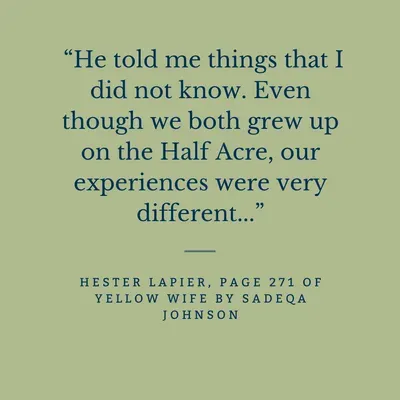
Pheby's eldest daughter, writing after the Civil War.
Read Yellow Wife.
First: if you love American history, this is a must-have for your historical fiction collection.
Buy Yellow Wife here. (and if you're interested, you can see more book recommendations on my Amazon storefront!)
Second: if you travel to Virginia, here are two calls to action:
- TRAVEL ITINERARY: If you visit us here in Virginia, I’m happy to put together a customized travel itinerary focused on this topic for you- it’ll take you from Williamsburg to Richmond and beyond based on your stay and preferences.
Click here to book a call and discuss it. (I'll be including a free walking tour of Colonial Williamsburg)
Closing words from history.
Abraham Lincoln, Washington, D.C. January 1, 1863
Two excerpts from the Emancipation Proclamation:
"That on the first day of January, in the year of our Lord one thousand eight hundred and sixty-three, all persons held as slaves within any State or designated part of a State, the people whereof shall then be in rebellion against the United States, shall be then, thenceforward, and forever free; and the Executive Government of the United States, including the military and naval authority thereof, will recognize and maintain the freedom of such persons, and will do no act or acts to repress such persons, or any of them, in any efforts they may make for their actual freedom.
…
And by virtue of the power, and for the purpose aforesaid, I do order and declare that all persons held as slaves within said designated States, and parts of States, are, and henceforward shall be free; and that the Executive government of the United States, including the military and naval authorities thereof, will recognize and maintain the freedom of said persons.”
Click here to read the Proclamation in full.
Are you enjoying the history I'm sharing on this blog? Keep me both caffeinated and able to bring you this free resource! Use my online tip jar and buy me a coffee:

There is a huge practical disclaimer to the content on this blog, which is my way of sharing my excitement and basically journaling online.
1) I am not a historian nor an expert. I will let you know I’m relaying the information as I understand and interpret it. The employees of Colonial Williamsburg base their presentations, work, and responses on historical documents and mainly primary sources.
2) I will update for accuracy as history is constant learning. If you have a question about accuracy, please ask me! I will get the answer from the best source I can find.
3) Photo credit to me, Daphne Reznik, for all photos in this post, unless otherwise credited! All photos are personal photos taken in public access locations or with specific permission.